


Lessons From SafeCrop’s 1000 RootED Initiative
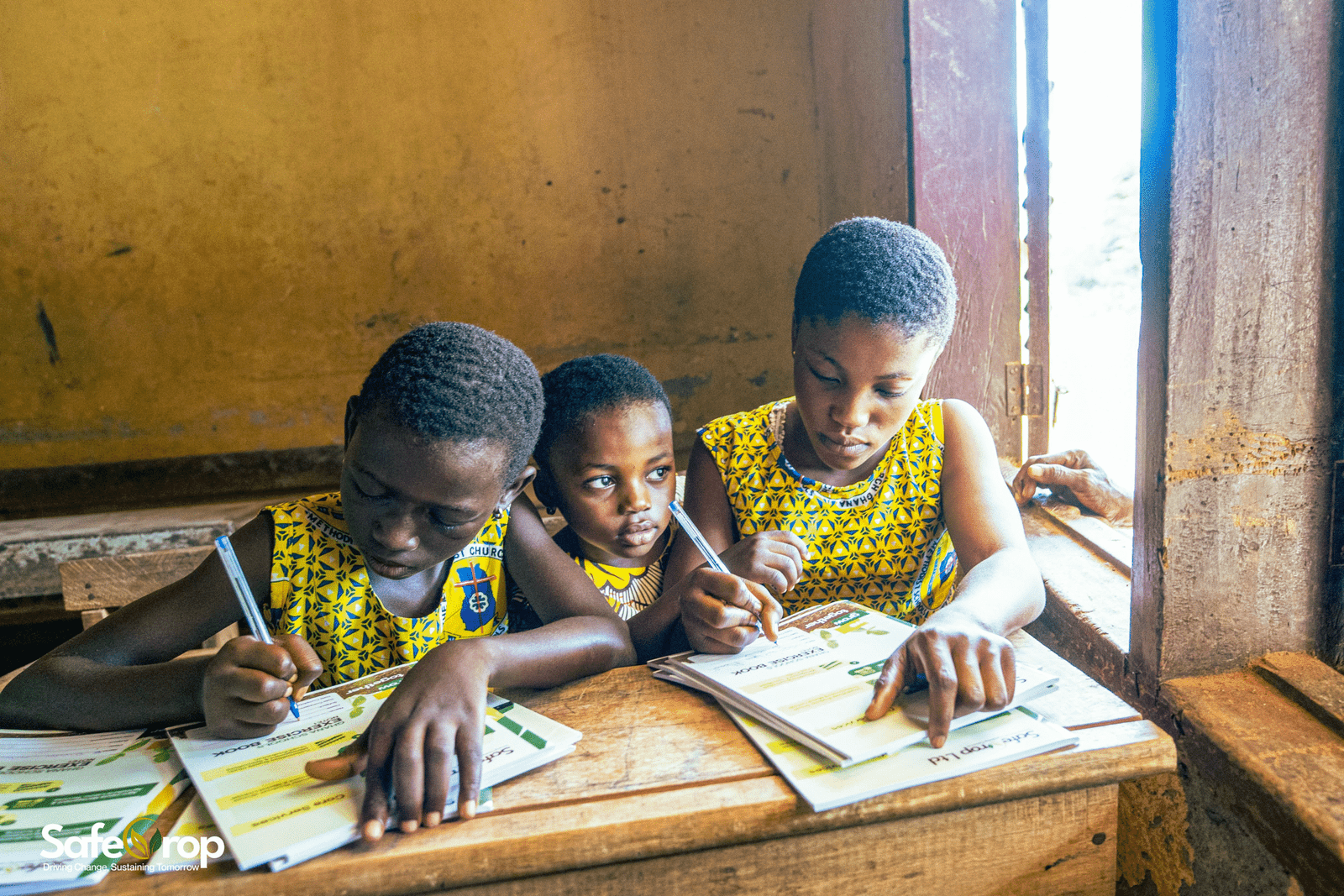
In September 2025, SafeCrop Ltd distributed 10,450 exercise books, 3,135 pens, 1,190 pencils, and 450 mathematical sets to 1,045 students in 14 cocoa-growing communities in Ghana. These numbers tell part of our story. At SafeCrop, we believe that education is essential to agricultural sustainability.
Conversations about poverty in cocoa-growing communities often focus on farm-gate prices, low incomes, and fluctuating global markets. However, one of the most powerful, and underestimated, levers for breaking the cycle of poverty lies beyond the farm: education. At SafeCrop, we believe that education is more than a social good. It is a strategic intervention capable of dismantling the intergenerational transmission of poverty that has trapped cocoa-farming families for generations. Our 1000 RootED “Back to School” initiative addresses a critical question facing the cocoa industry: How can we ensure that farmers’ children have opportunities and contribute to increased yields instead of perpetuating poverty?
The Cocoa Poverty Cycle: Why Education Matters
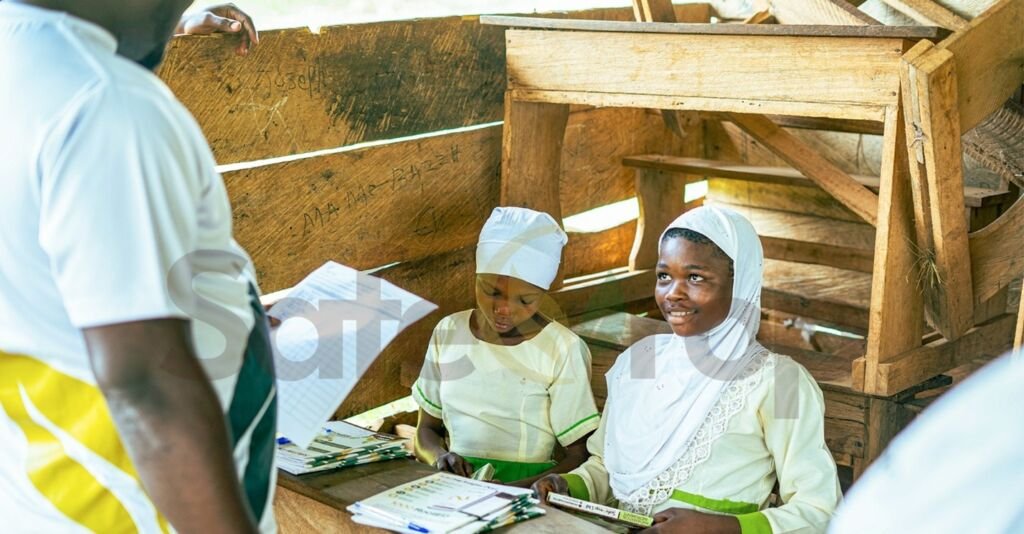
The numbers are stark and unambiguous. It is estimated that 1.56 million children are engaged in child labour in Côte d’Ivoire and Ghana, accounting for 45% of children living in households that grow cocoa. Almost all of these children work on family cocoa farms, not due to exploitation by strangers, but because their families cannot survive without their labour.
In both countries, most cocoa farmers earn an income below the poverty line, which is why they often rely on child labour to remain competitive. This creates what researchers call ‘the vicious cycle’: poverty forces children into farm work; farm work disrupts education; lack of education limits future earning potential; and limited earning potential perpetuates poverty for the next generation.
Cocoa farming households face a unique set of constraints:
- Highly variable seasonal incomes
- Large family sizes
- High dependency on manual labour
- Limited access to quality educational infrastructure
- Persistent financial pressure during school resumption periods
When children miss school due to lack of materials, the long-term effects compound:
- Lower educational attainment
- Reduced literacy and numeracy
- Fewer livelihood opportunities
- Higher vulnerability to poverty
- Increased risk of child labour in peak seasons
What We Did: A Data-Driven Back-to-School Campaign
Our 2025 Back-to-School outreach focused on reducing these barriers by providing the supplies children need to start the school year with confidence.
The Numbers that matter:
- 1,045 students reached.
- 14 schools across multiple districts: Assin Central, Ahafo Ano South, Tano North, Asunafo North, and Upper Denkyira
- 10,450 exercise books distributed (averaging 10 books per student for a full school year)
- 3,135 pens & 1,190 pencils provided
- 450 mathematical sets supplied, strengthening numeracy readiness
- Distribution through 6 partner farmer cooperatives, including women-led groups
- Beneficiaries included 595 primary and 450 junior high students
In communities where families struggle to meet basic needs, these materials are not minor additions; they are major turning points.
For many households, this support meant:
- Reduced financial pressure at school reopening
- Improved attendance within the first week
- Children entering school are prepared, confident, and motivated
- Renewed trust and cooperation between SafeCrop, community leaders, and schools
The project also strengthened SafeCrop’s relationships with cooperatives in Assin Central, Ahafo Ano South, Asunafo North, Tano North, and Upper Denkyira. This has built a stronger foundation for future educational interventions under the RootED umbrella, as well as for our cocoa business endeavours.
The Distribution Model
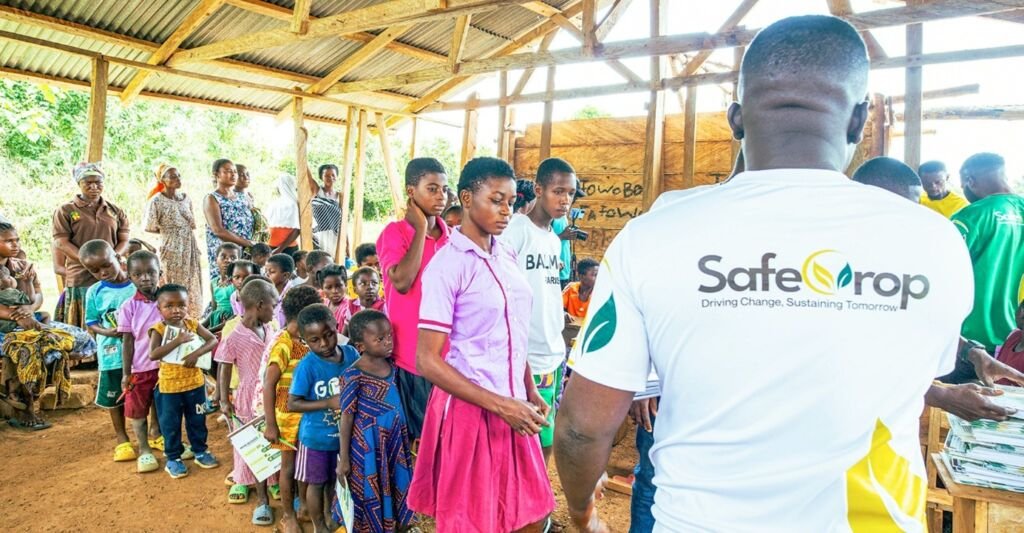
We implemented a distribution system based on cooperative-led lists and school registers to ensure transparency and accuracy of targeting. School administrations verified student enrolment. This multi-stakeholder verification process guaranteed that the materials reached those who needed them most. The distribution events became community celebrations, bringing together parents, teachers, cooperative leaders, and SafeCrop field officers to publicly affirm the value of education. These symbolic moments matter. They send children the message that their education is important and that adults are investing in their future.
Why This Model Works: The Evidence
The key is integration. Education interventions work best when embedded in broader agricultural development strategies. When we provide both certification and agricultural extension services (helping farmers improve yields and incomes) and educational support (helping their children access quality schooling), the effects are synergistic.
When we invest in education, we’re not just helping individual children; we’re also building the community’s capacity for self-determination and innovation. Access to education reduces the prevalence of child labour by providing an alternative to working and making children less vulnerable to exploitation in labour markets. It also equips them with the skills needed for future employment, thereby helping to break the intergenerational cycle of poverty. Furthermore, when today’s students become tomorrow’s farmers, equipped with a secondary or tertiary education, they will implement sustainable practices, adopt technology, and make strategic decisions that will increase productivity and profitability.
This is exactly our strategic intent: create alternatives, expand possibilities, interrupt the cycle.
The Business Case for SafeCrop
Some might question why an agricultural company should invest in education. The answer is simultaneously strategic and moral.
Strategically, the cocoa sector faces an existential crisis. Virtually all cocoa in West Africa is produced by smallholder farmers, many of whom are poor, and for the third consecutive year, cocoa supply is projected to lag 8.5 percent behind global demand this season. The sector needs innovation, productivity improvements, and sustainable practices. These require educated farmers and agricultural professionals. If the next generation of cocoa farmers lacks education and sees farming as a poverty trap, who will grow cocoa in 20 years? We need young people who choose agriculture because it offers opportunity, not because they have no alternatives. Education creates that choice. Morally, we recognize what researchers have documented: child labour is a direct result of the poverty prices companies pay cocoa farmers for their cocoa, with one farmer explaining explicitly that their children would be at school if they had more money. While SafeCrop works to improve farmer incomes through fair pricing, better extension services, and market access, we also acknowledge our responsibility to directly support children’s education.
The Future We Are Planting
The 2025 RootED Back-to-School initiative made one truth clearer than ever:
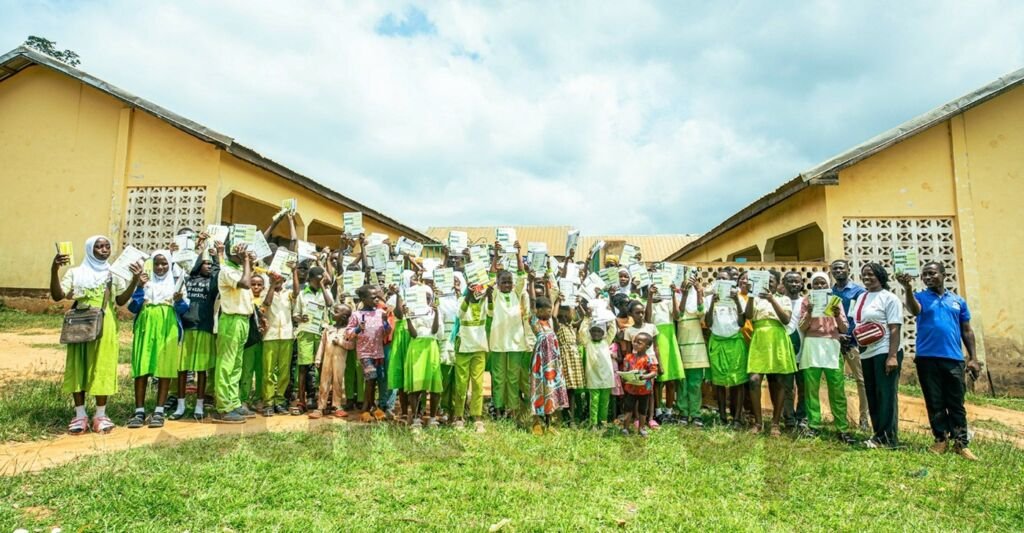
When a child receives the tools to learn, an entire community takes a step forward.
SafeCrop will continue to invest in the next generation, both because it is the right thing to do and because it is a strategic move. Strong minds lead to strong farms and communities, and a stronger agricultural future for Ghana. We envisage becoming the number one stakeholder in Ghana’s agricultural landscape. SafeCrop alone cannot break the cocoa poverty cycle. However, we can demonstrate what is possible. We can show that educational interventions led by cooperatives and designed in genuine partnership with communities can produce measurable results.
We invite peer companies in the cocoa and broader agricultural sectors to develop similar programs. Healthy competition in terms of social impact motivates us to see who can most effectively support educational access. We also invite development partners to collaborate with us on research, monitoring and programs design, so that your expertise in education and poverty reduction can strengthen our interventions. Finally, we invite government institutions to back systemic reforms that remove the root causes of educational barriers, such as better teacher deployment to rural areas, targeted infrastructure investments and curricula that reflect the realities of agricultural communities.
WE GROW TOGETHER.
Additional Read.
Harvard International Review (Retrieved Nov. 2025) Bittersweet: The Harsh Realities of Chocolate Production in West Africa. https://hir.harvard.edu/bittersweet-the-harsh-realities-of-chocolate-production-in-west-africa/
