



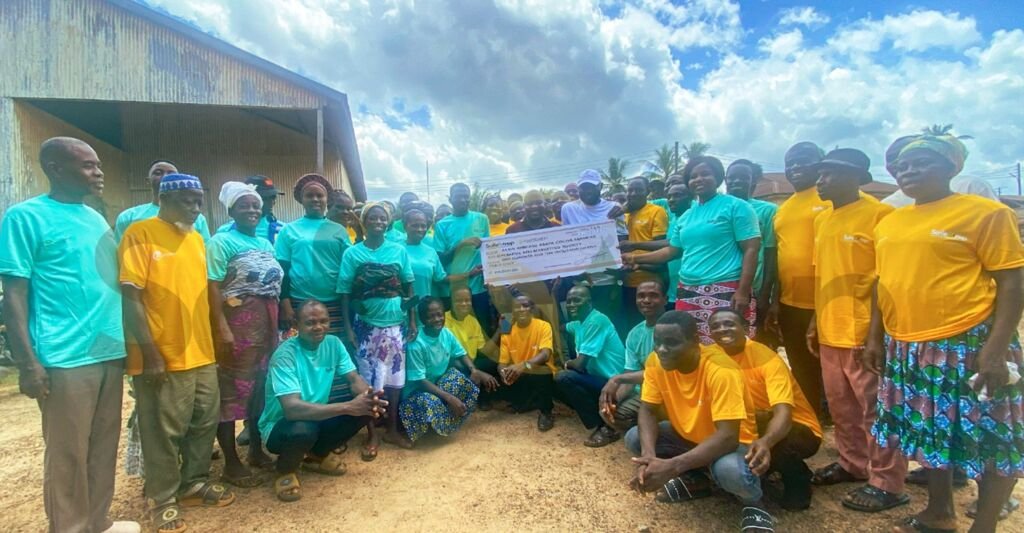
On January 6, 2025, something powerful happened in two cocoa-farming communities in Ghana. At Subompang and Assin Fosu, SafeCrop Ltd presented checks totaling GH₵ 536,910 to farmer cooperatives, not as charity, but as earned returns from their own agricultural success.
Anidaso Mmaa Cocoa Farmers’ Cooperative and Marketing Society: GH₵ 220,000
Adwumapa Cooperative Farmers’ Cooperative and Marketing Society: GH₵ 206,910.00
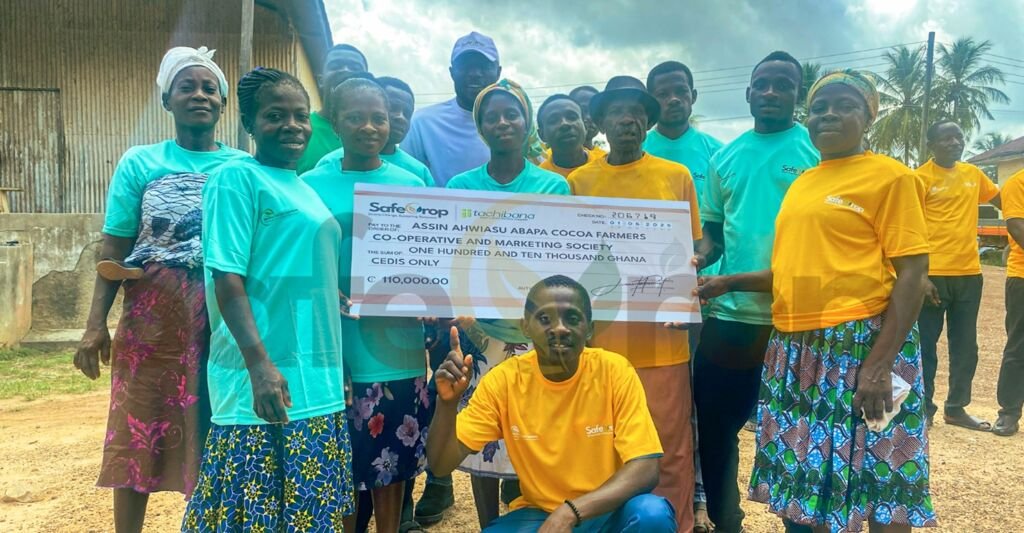
Assin Ahwiasu Abapa Cocoa Farmers’ Cooperative and Marketing Society: GH₵ 110,000
These weren’t grants nor donations. They were CSR funds and farmer premiums generated directly from cocoa sales. This was money flowing back to the communities that produced it.
This is what circular value looks like. This is what happens when agricultural businesses recognize that their success and community prosperity are not separate goals but interconnected realities.
This is part of SafeCrop’s goal: agriculture funding community development.
The Extractive Model We’re Leaving Behind
For too long, agricultural supply chains have operated on an extractive model: value flows in one direction, from rural communities to urban centers, from producers to processors, and from the Global South to Global North.
Cocoa farmers produce the raw material that becomes a global chocolate industry worth over $130 billion annually. Yet these same farmers often earn less than $1 per day, live in communities without basic infrastructure.
The traditional model looks like this:
Farmers grow cocoa → Companies buy cocoa → Value leaves community → Communities remain poor → Cycle repeats
This isn’t sustainable. Economically, it creates unstable supply chains dependent on impoverished producers. From a social perspective, it perpetuates intergenerational poverty and drives rural decline. From an ethical standpoint, it is indefensible.
The Circular Value Model: A Different Approach
Our model operates on a fundamentally different principle: agricultural success should generate community prosperity.
Here’s how it works:
Farmers produce quality cocoa → Farmers receive fair prices + premiums → Cocoa sales generate profits → Portion returns to cooperatives as CSR funds + individual farmers receive premiums → Cooperatives invest in community development → Stronger communities produce better cocoa → Cycle strengthens
This is circular value creation, a concept researchers refer to as a “collaborative commons model,” where profits are reinvested into the community, and stakeholders share in decision-making power.
Research shows that businesses prioritize local needs and reinvest profits into social, environmental, or economic initiatives that benefit the entire community, creating strong, resilient communities that can better withstand economic shocks.
Early this year, premium launches in Subompang and Assin Fosu demonstrated this model in action.

What Happened: The Premium Launches
Both events brought together farmers, cooperative leaders, community members, and SafeCrop representatives to celebrate agricultural success and reinvest in community futures.
Subonpang: Anidaso Mmaa Cooperative – GH₵ 220,000 & Adwumapa Cooperative – GH₵ 206,910.00
Anidaso Mmaa is an all-women cooperative, a group of female cocoa farmers who have built a thriving agricultural business through collective effort. The GH₵ 220,000 delivered to their cooperative represents recognition of their quality cocoa production and commitment to sustainable farming practices. These funds will support cooperative operations, farmer welfare initiatives, and when accumulated with future disbursements, community development projects determined by the cooperative leadership.


Assin Fosu: Abapa Cooperative – GH₵ 110,000
At Assin Fosu, the Abapa Cooperative received GH₵ 110,000 under the same model. This cooperative has been a steadfast partner in SafeCrop’s operations, consistently delivering quality cocoa while maintaining strong community relationships.
Like Anidaso Mmaa, these funds empower the cooperative to strengthen its operations, support member welfare, and invest strategically in community priorities.
The Premium Structure
In addition to CSR funds, individual farmers received premiums based on the volume of cocoa they delivered. These premiums are tied to certification standards, in this case, Rainforest Alliance requirements, and reward farmers for meeting quality and sustainability criteria.
The premium model accomplishes multiple objectives simultaneously:
Individual Benefit: Farmers receive direct financial rewards for their work, supplementing farm gate prices.
Quality Incentive: Premiums tied to certification incentivize adoption of good agricultural practices.
Cooperative Strengthening: CSR funds help build institutional capacity for cooperatives to better serve their members.
Community Investment: Accumulated funds enable cooperatives to address community-level needs.
This isn’t a one-time event. It’s an annual commitment, a structural feature of how SafeCrop does business.

The Strategic Rationale: Why SafeCrop Invests This Way
Some might question: Why should an agricultural company redirect profits back to cooperatives? Isn’t the goal to maximize shareholder returns?
Our answer is simple: this model maximizes long-term value for everyone, including SafeCrop.
Supply Chain Stability
When farmers know they’ll receive premiums and their cooperatives will receive CSR support, they commit to long-term partnerships. We don’t compete for cocoa during harvest season because farmers choose to sell elsewhere. We build relationships where farmers want to work with us because doing so benefits them directly and tangibly.
Quality Improvement
Premium payments tied to certification standards create powerful incentives for quality. Farmers who meet Rainforest Alliance criteria earn more. Farmers who adopt good agricultural practices see rewards. Programs that incentivize practices like pruning and agroforestry lead to 70 percent adoption of high-quality tree pruning and contribute to 18 percent increases in cocoa yields. When quality generates premiums, quality improves. When cooperatives have resources to invest in training and equipment, productivity increases.
Community Resilience
Agricultural supply chains cannot be sustainable if the communities producing raw materials are collapsing under poverty, lack of education, inadequate healthcare, and declining infrastructure. Value-added agriculture with attention to social and environmental values supports community wealth creation, with shared values supporting distribution of premiums across supply chains and demonstrated commitment to community by food system participants. Strong cooperatives with financial resources can address community challenges, from education to healthcare to infrastructure, that ultimately affect agricultural productivity.
Reputation and Market Access
Consumers and retailers increasingly demand transparency about where products come from and how producers are treated. Companies that demonstrate genuine commitment to farmer welfare gain competitive advantages.
Independent third-party verification confirms that benefits such as premium payments are passed to farmer organizations, driving learning and reporting transparency. SafeCrop’s model isn’t just ethical, it’s marketable. We can tell buyers and consumers that the cocoa they purchase directly funds community development, with transparent, verified processes.
The GH₵ 330,000 distributed in March represents our commitment, but it’s just the beginning.
